Communicating Potential Investment Opportunities in Africa
Five MSAI students used their Practicum project to help support AI-empowered investment platform Kilwa.
The population of Africa is young and fast-growing, powering many of its nations to the cusp of becoming some of the world’s most dynamic economic engines.
For investors, that combination of youth, scale, and momentum represents a rare opportunity. For five students in Northwestern’s Master of Science in Artificial Intelligence (MSAI) program, that opportunity became the foundation of their Practicum project—and a chance to build something real.
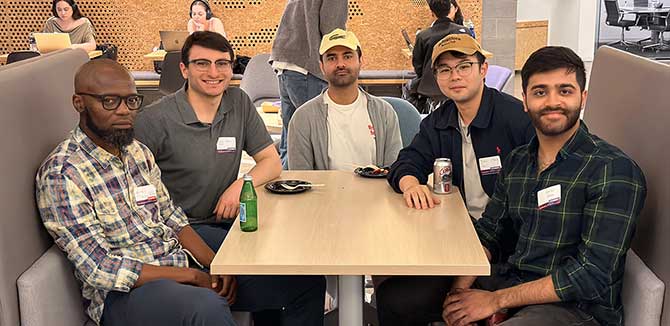
Adeshvir Dhanoa (MSAI ’26), Naman Dua (MSAI ’26), Yitao Hong (MSAI ’26), Jatin Hooda (MSAI ’26), and Jordan Johnson (MSAI ’26) spent their third quarter working with Kilwa, an AI‑empowered startup focused on unlocking investment potential across Africa.
“This project was applicable to a real-world scenario and something we might see in our job functions post-graduation,” Jordan said. “It was a super-positive experience.”
MSAI’s Practicum in Intelligent Systems course challenges students to design and develop solutions to open-ended AI problems. Instead of textbooks or theoretical exercises, students learn by doing. In this case, they helped build an AI-driven platform that aims to deliver real-time, trustworthy investment information from across an entire continent.
With a median age of just 19 and a population projected to reach 2.5 billion by 2050, Africa is home to 11 of the world’s fastest-growing economies—each expanding at more than 6 percent annually.
Working closely with Kilwa founder Hinsley Njila, the students set out to create an application that could ingest investment-related news from diverse sources and languages, filter out unreliable content, and present structured insights to busy investors.
“MSAI students bring current, rigorous AI training and fresh eyes to problems we live with every day,” Hinsley said. “A startup like ours benefits enormously from people who haven't yet been told what's impossible. They ask questions a seasoned team stops asking.”
The challenge was not simple. While major US outlets cover Africa, some of the most valuable information comes from small regional publications—even village-level sources. Identifying credible reporting, extracting unstructured text, and transforming it into structured, investor-ready data required both technical skill and creativity.
“That was a huge obstacle that we had to overcome, finding a happy medium to just try and get that information from those news sources,” Jordan said. “Then we were able to extract the unstructured texts from those articles and structure it.”
For the students, the experience was transformative.
“It gave me so much real-world working experience and was not just research you do on campus in school,” Yitao said. “It also made me realize that Africa has huge potential.”
Yet one of the most important lessons had little to do with model architecture or data pipelines. It came from a core principle emphasized throughout the MSAI program: the ability to communicate.
"With the use of AI, technical work is going to change," Adeshvir said. "So it's the way that you present your technical work and how you can go about problem solving which is really important. Nobody wants to hear a lot of technical jargon thrown at them, especially if they're not within the field."
Jordan agreed.
“MSAI’s leaders have from day one instilled in us this idea that the most important part of this program isn’t going to be mastering the math and statistical knowledge needed to do these different machine-learning tasks,” Jordan said. “Being able to explain a product or service at a super high level to stakeholders is really important.”
Their most important stakeholder was Hinsley himself—and the collaboration became a highlight of the project.
“It was energizing,” Hinsley said. “They treated it like real work, not a class assignment. They communicated well, took feedback seriously, and weren't shy about challenging our assumptions. That is exactly what you want from a team.”