Exploring a Cosmic Phenomenon
Three MSAI students used their practicum project to collaborate with the NSF-Simons AI Institute for the Sky, delving into the mysteries of black holes and improving a simulation to project them into the future.
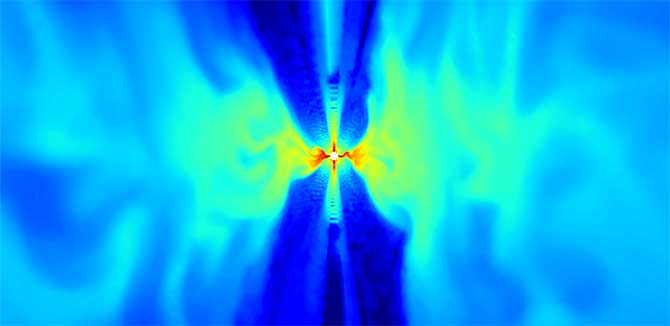
A black hole is a region in space where matter is crushed into an infinitely dense point, creating a gravitational pull so intense that nothing can escape. Once any object or light crosses its outer boundary, known as the event horizon, it is trapped forever. That reality, combined with the fact that the closest black hole to Earth is more than 9,000 trillion miles away, creates unique challenges for studying the phenomenon.
Students in Northwestern Engineering's Master of Science in Artificial Intelligence (MSAI) program are trying to make the process a little more manageable.
Aryan Dwivedi (MSAI '26), Eden Growney (MSAI '26), and Kevin Fortune (MSAI ‘26) collaborated this spring with scientists at the NSF-Simons AI Institute for the Sky (SkAI), a national research center dedicated to combining AI with astrophysics to manage and decode massive deep-space data sets.
“We know scientifically that black holes do exist,” Aryan said. “The only way people can study these things is through simulations, but (the Institute was) struggling with how to make it into a simulation that can scale into the future.”
The students’ job was to take an existing simulation and improve it so it could be projected into the future to help determine what a black hole might be doing in 10 years, 100 years, or 100 million years.
The project was for MSAI's Practicum in Intelligent Systems course, where students collaborate with faculty and researchers from across Northwestern to try and solve an open-ended AI problem. The goal is to provide students with practical experience and emphasize the importance of learning by doing.
SkAI is part of the Northwestern Center for Interdisciplinary Exploration and Research in Astrophysics, made up of 25 partner organizations, and funded by the US National Science Foundation and the Simons Foundation.
“The main challenge that we're trying to address with this acceleration is the disparate, dramatic, gigantic, ginormous scale separation in nature, particularly when it comes down to black holes feasting on the surrounding gas,” said Sasha Tchekhovskoy, associate professor in the department of physics and astronomy at the Weinberg College of Arts and Sciences and an adviser on the students’ practicum project. “If you want to understand how the black hole grabs that stuff from that distance, you need to be able to follow it.”
Each student explored a different approach to improve the model and found some success. This fall they are continuing to support SkAI, providing the opportunity to try and integrate their approaches.
“Each of these pieces that we worked on were not unrelated and could actually fit together,” Eden said. “We’re going to give them a framework for how these approaches can fit into the architecture sequentially.”
The team’s advisers are excited about the students' progress and their caliber of work.
“They have the right kind of training and mindset,” said Ermin Wei, associate professor of electrical and computer engineering, industrial engineering and management sciences and (by courtesy) computer science at Northwestern Engineering. “This is a different kind of project, where the students are interested in getting their hands dirty to play with data, try different models, and see how they work. It gives them a way to use that knowledge from the classroom in a real-world setting.”
And it just might one day lead to greater understanding of one of the universe's most alluring mysteries.
“Since childhood, I have had a fascination with figuring out what exactly a black hole is,” Aryan said. “It's a very mystifying thing, and there's no better way to learn about it than working on it.”