Improving Robotic Equipment Modeling and Simulation
Five students from MBAi and MSAI worked with Intrinsic, an AI and robotics software company, to make generating digital equipment representations faster and more intuitive.
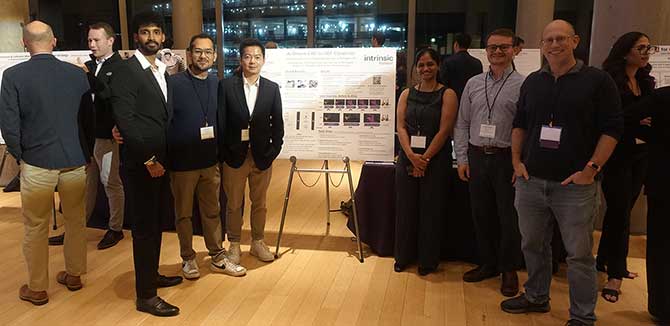
Dan Kamerling had a challenge he wasn't sure was solvable.
Dan was group product manager at Intrinsic, an AI and robotics software company that focuses on making industrial robots more accessible, intelligent, and easier to program.
"In the robotics industry, integration of equipment from a variety of equipment vendors into a digital twin is challenging," he said. "Each vendor has their own conventions, descriptions, and quality of information, yet these still need to be converted into a format that can be understood for robotics control and simulation."
That conversion process currently takes days, but Dan wondered if there was a way to use AI and open source software to reduce that time from days to minutes. To find out, he and Intrinsic turned to a team of students from Northwestern Engineering's Master of Science in Artificial Intelligence (MSAI) program and Northwestern's MBAi Program, a joint-degree program offered between the Kellogg School of Management and Northwestern Engineering.
The collaboration was part of the Industry Capstone project, a 10-week course where students from both programs work on an AI-focused project presented by a partner company.
“This type of project reflects the reality of day-to-day work out in the world,” said Dan, who now is a group product manager at Netflix. “The collaboration of MBAi understanding what is an important problem and MSAI figuring out how to solve that problem is critical to business success.”
Arjun Anbazhagan (MSAi '25), Bradley Argauer (MBAi '26), Palash Jain (MBAi '26), Zach Jiang (MBAi '26), and Sree Dhyuti Nimmagadda (MSAI '25) were up for the challenge.
“In a lot of programs, you work on cases that have a right answer in the back of the book," Zach said. "Here, there was no book."
The problem is one that, on the surface, seemed tailor-made for an AI solution: Take the laborious manual task of standardizing information from a variety of sources to create a truly unified shared language.
Doing that was both a nuanced and complex task.
“As an MBAi student with a semiconductor background, I immediately saw the massive business value,” Zach said. “But at the same time, I knew we were dealing with raw geometric data and complex robotics kinematics, which isn't exactly a solved problem in AI yet.”
By the end of the 10-week course, the students created an AI-assisted pipeline that automates the most tedious parts of the conversion process. During their testing, the students saw a 70-85 percent reduction in manual effort needed for the conversion process.
Their solution would not have been possible without the collaboration between the two programs.
"My instinct was to jump straight into building, but our MBAi teammates kept pushing us to do more customer interviews first and really understand the pain points before writing any code," Sree said. "That discipline ended up shaping what we built in a meaningful way."
Zach said the knowledge exchange went both ways.
"Working alongside the MSAI students pushed me to not just stay at the surface level of 'we're using AI for this,'" he said. "I had to actually understand how the reasoning model was analyzing geometry, why certain clustering approaches worked better than others, and what the tradeoffs were in different architectural decisions. That deeper technical fluency made me a better product manager on this project because I could have more meaningful conversations about feasibility and tradeoffs."
By working together, they also saw what Dan meant about today's workforce realities. The experience collaborating across programs was one they all believed will help make them better professionals—and more standout job candidates.
“This is how real AI products get built in the real world,” Zach said. “You need people who can go deep on the technical implementation and people who can zoom out and think about user needs, business viability, and go-to-market strategy. Neither skill set alone is sufficient.”