Biotech Veterans Discuss the Impact of AI
Four industry experts talked about the emergence of artificial intelligence and what MBP students can do to embrace the technology — and its potential.
Like many professionals, Anju Samy had a choice. She could resist AI and pretend it would not impact her job as executive director and head of regulatory affairs at COUR Pharmaceuticals Development, or she could explore the emerging technology's potential.
"AI is here and it's here to stay," Samy said. "Instead of fighting it, we embrace it. That's what we're trying to do."
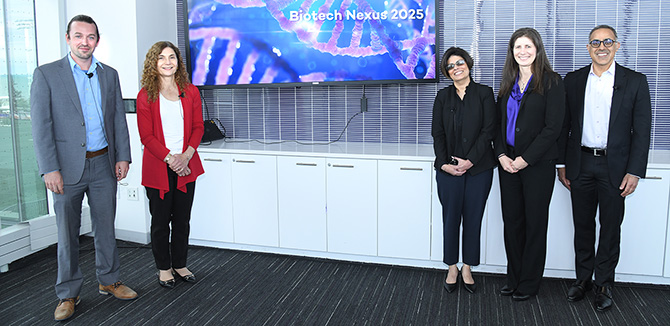
Samy discussed her attitude toward AI at Biotech Nexus, an annual panel discussion hosted by Northwestern Engineering's Master of Biotechnology Program (MBP). The event is an opportunity for students and MBP alumni to learn from and connect with leaders from across the biotechnology space.
Samy explained that she is fascinated to see how AI could improve efficiencies within regulatory affairs and augment the work done by humans, particularly at a small company like hers.
COUR is a clinical-stage biotechnology company looking to reprogram the immune system to restore health in people suffering from autoimmune diseases.
Joining Samy at this year's event were Jeff Ehrhardt, chief operating officer at Shreenika; Elizabeth Goodrich, technical R&D director at MilliporeSigma; and Ameet Mallik ('94, MBP '95), CEO at ADC Therapeutics.
MBP director Danielle Tullman-Ercek hosted the panel conversation. AI and automation were major topics of discussion during the event.
"AI is going to change the landscape for protein design and protein utilization," Ehrhardt said. "It's going to be a power multiplier for any scientist that works at a bench."
Mallik agreed.
"It's going to lead to more efficiency," Mallik said. "It's going to enable innovation at a much faster pace."
While many industries face questions of whether AI will replace people in the workforce, the Biotech Nexus panel believed there will be room for AI alongside humans.
Mallik likened the arrival of AI and machine learning to the launch of Google back in 1998.
"At the end of the day, they're all tools to help you make better decisions," he said. "A machine can't come up with the right question to ask. (AI) is going to fundamentally change a lot of jobs, but I don't think it's going to replace human beings in terms of some of the higher order thinking that's going to be required."
Goodrich, who's spent the past 26 years at MilleporeSigma, advised MBP students to spend their time in the program dabbling with AI. She encouraged the students to understand how AI works — and how it can better support their work both now and in the future.
"The more comfortable you are working with data is very important," she said. "It's easy these days to be buried in data and have more than you're able to process. We want to be able to make sense of all that data."