

Pioneering Strained Layer Superlattice Technology
Manijeh Razeghi was recognized by NASA for foundational contributions to SLS infrared detector technology
From Quantum Theory to Cutting-Edge Devices
The visible light spectrum that humans perceive spans only a small portion of the electromagnetic spectrum — roughly 430 to 750 THz, corresponding to wavelengths of ~400-700 nm. Just beyond this range lies the infrared (IR) region, which captures thermal emission from any object with a temperature above absolute zero (0 K or -459.67 °F). Infrared imaging finds applications in automotive safety, gas‐leak detection, medical diagnostics, planetary science, and search and rescue in low visibility conditions.
The concept of Type II strained layer superlattices (SLS) was first introduced in 1971 by Leo Esaki — a Nobel Laureate in physics — and Daniel C. Tsui. They theorized that alternating ultrathin layers of semiconductor materials could produce a staggered, or Type II, band alignment — separating electrons and holes across material interfaces. This enabled engineered bandgaps and prolonged carrier lifetimes by leveraging strain and quantum confinement. Initially a theoretical pursuit in quantum transport, this concept later proved perfect for engineering infrared sensitive detectors — especially when adapted to antimonide semiconductor systems such as GaSb/InAs or InAs/InAsSb SLS, providing tunable mid wave and long wave IR detection.
Breakthroughs in Strained Layer Superlattice Technology
 Over the past three decades, I and my team at the Center for Quantum Devices (CQD) at Northwestern University have pioneered the development, refinement, and commercialization of Sb based Type II SLS — bringing Esaki and Tsui’s vision to practical fruition in advanced IR photodetector and imaging systems.
An SLS is formed by stacking ultra-thin layers of semiconductors with differing lattice constants, inducing purposeful strain. The resulting quantum confinement enables precise tuning of electronic and optical properties, yielding devices with low dark current, high sensitivity, narrow spectral selectivity, and improved carrier lifetime ideal for IR applications.
Antimonide SLS systems — such as GaSb/InAs and InAs/InAsSb — feature Type II band alignment: the conduction‐band minimum of one layer (InAs) resides below the valence‐band maximum of its neighbor (GaSb). This unique staggered structure enables narrower effective bandgaps, perfect for mid and long-wave IR detection. By tuning layer thickness and composition, the absorption characteristics can be finely controlled.
CQD’s innovation also includes Ga free (InAs/InAsSb/AlAsSb) SLS designs, which reduce structural defects and production costs, while maintaining — or even surpassing — the performance of traditional GaSb/InAs-based SLS detectors.
Our Ga-free designs are easier to grow with fewer dislocations yet match or exceed the performance of traditional GaSb InAs /AlSb-based SLS detectors. They also significantly reduce production costs.
Transitioning from Prototype to Focal Plane Arrays
In 2003, the CQD team achieved a historic milestone: the first focal plane arrays (FPAs) based on antimonide SLS, including both with GaSb/InAs as well as Ga-free InAs/InAsSb large-format, single- and multi-color variants.
These FPAs assemble thousands of SLS detector elements (“pixels”) into a two-dimensional imaging array — akin to the sensor in a digital camera but sensitized for infrared light. These arrays demonstrated performance breakthroughs — outpacing legacy mercury cadmium telluride (HgCdTe) detectors and imagers.
No group had fabricated an SLS based focal plane array until ours. We built the world’s first infrared camera based on Sb superlattices—and since then, multiple generations of arrays have consistently outperformed HgCdTe systems.
NASA Recognition and Space Technology Hall of Fame Induction
In 2025, NASA recognized my foundational work on SLS infrared detectors. The Ga-free superlattice infrared detector is also one of two 2025 inductees to the Space Foundation’s Space Technology Hall of Fame.
These detectors operate efficiently at relatively high temperatures, reducing or eliminating the need for cryogenic cooling. This breakthrough yields IR systems that are lighter, more power-efficient, and more versatile for both terrestrial and space applications.
The GaSb/InAs and InAs/InAsSb SLS platforms offer a rare combination of performance, spectral tunability, cost efficiency, and substrate versatility. They’re ideal for cutting edge scientific missions as well as emerging commercial uses.
Real World Applications: Earth and Space
- International Space Station (ISS): In 2018, the first SLS based IR camera was deployed on NASA’s Robotic Refueling Mission #3.
- Landsat 9 Satellite: Launched in 2021, it uses SLS technology in its thermal infrared sensor to capture high-precision surface temperature data — crucial for tracking climate change, managing water resources, and monitoring land use.
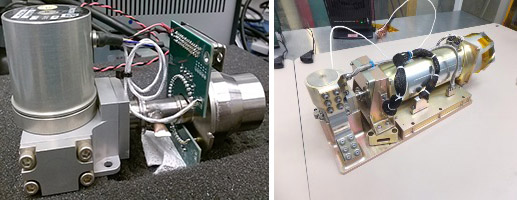
SLS based detectors and FPAs are transforming how we observe Earth and explore the cosmos.
On Earth, CQD’s SLS FPAs play pivotal roles in:
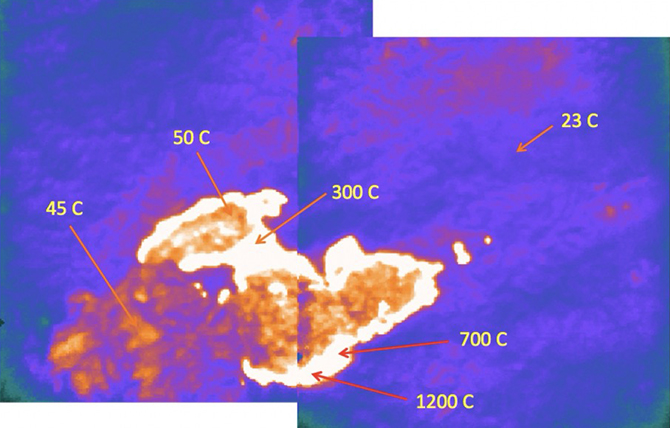
- Wildfire detection: Integrated within drones and satellites, these sensors can rapidly identify ignition points and map fire progression—assisting first responders.
- NASA’s Compact Fire Imager uses SLS FPAs to deliver real time situational awareness.
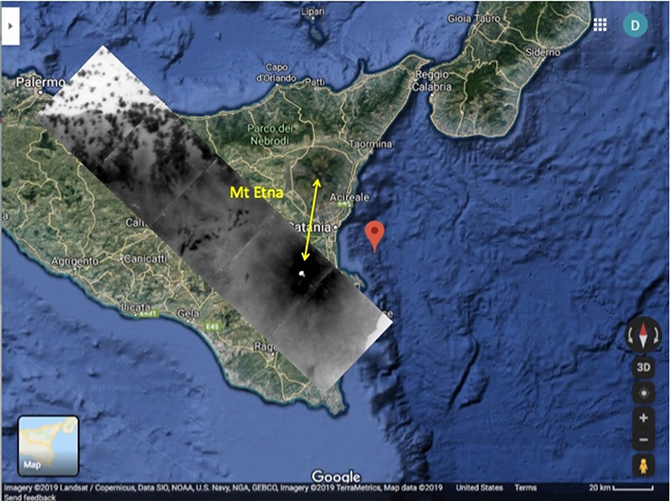
- Volcano monitoring: SLS detectors allow high-resolution mapping of lava flows, gas plumes, and surface temperature shifts — helping to predict eruptions.
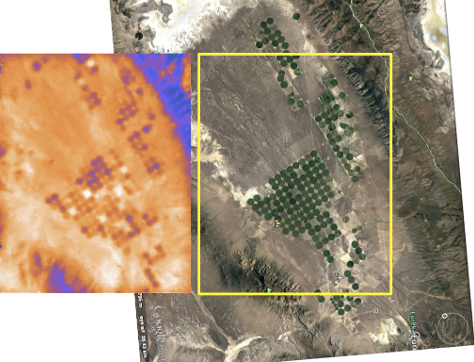
- Agriculture: SLS based imaging supports early detection of drought stress, disease, and irrigation inefficiencies — often before visible symptoms emerge.
Our GaSb/InAs and InAs/InAsSb SLS technology is becoming a cornerstone of modern sensing — from disaster response and climate-smart farming to planetary science and national security. It helps us see the unseen — when it matters most.
Timeline: From Hypothesis to Global Impact
| Year | Milestone |
|---|---|
| 1971 | Esaki & Tsui propose Type II quantum superlattices |
| 2003 | CQD demonstrates the world’s first Sb based SLS focal plane arrays |
| 2018 | First SLS based IR camera launched on ISS |
| 2021 | Landsat 9 deploys SLS thermal infrared sensor |
| 2025 | SLS technology inducted into Space Technology Hall of Fame |