A Robot-Assisted Solution for Spinal Surgery
Kassidy Shedd (MSR '24) used her MSR final project to explore how to make robot-assisted surgeries more accessible.
Kassidy Shedd (MSR '24) has spent years fascinated by medical technology and how it can help people. She has a particular interest in surgical robots, but she knows their high price tag puts them out of many hospitals’ reach.
For her final project in Northwestern Engineering's Master of Science in Robotics (MSR) program, Kassidy worked with Najib El Tecle, a neurosurgeon and assistant professor of neurological surgery in Northwestern Feinberg School of Medicine.
"I wanted to work on a solution that could make this kind of technology more accessible," she said. "The idea was to build something low-cost that could still improve precision and safety during surgery, giving more patients access to high-quality care, regardless of location."
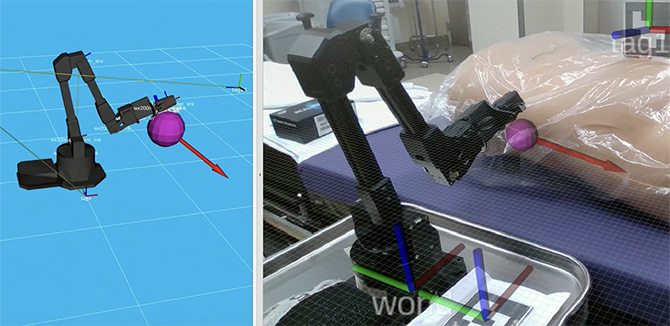
Kassidy developed a working proof of concept for a low-cost, robot-assisted solution for spinal surgery, focusing primarily on spinal injections. The project utilized a C-Arm X-ray machine that took two images 90 degrees apart from one another. Her code then used those images to execute a 3D path for the surgical robot to properly position the needle.
As part of the project, El Tecle provided real-world expertise as well as access to an operating room and X-Ray machine so the robot could be tested in realistic conditions. Kassidy also witnessed a live spinal surgery to provide her with first-hand context for the robot’s intended end use — an experience she said she won't soon forget.
Kassidy worried early on that determining that 3D path to guide the needle would be the biggest obstacle for her. In reality, calibrating the C-Arm X-ray machine was most challenging because of difficulties identifying the machine's intrinsic parameters, which differs significantly from standard computer-vision problems.
"I learned how to break down really complex problems into manageable pieces," she said. "There were a lot of moments where I felt stuck or overwhelmed, but I learned to pause, reassess, and try a new approach."
That mentality is one she honed in MSR.
"MSR taught me that even when something feels impossible, there is usually a way through it if you stay focused and keep trying," Kassidy said. "That mindset really helped during this project, especially when things got frustrating. I was often reminded that my progress doesn’t have to be perfect, I just have to keep moving forward."
She continues to do just that. Following graduation, Kassidy moved to New Mexico. Today she is a post-master's intern at the Los Alamos National Laboratory (LANL).
Her current focus is on research and development for robotics and automation.
"I have used the same mindset of staying persistent and not being afraid to try different approaches," she said. "At LANL, I work on challenging problems, and being able to stay calm, creative, and flexible makes a big difference."
Looking back on her robot-assisted solution for spinal surgery, Kassidy is proud of what she accomplished. Most importantly, she is grateful the experience — and the duration of her time in MSR — transformed how she approached problem solving.
It's an approach she still relies on.
"MSR really helped me grow into someone who doesn’t just accept things at face value," she said. "I’ve learned to dig deeper, to understand how and why things work, and to put my all into the work I care about. I became someone who is not afraid to take on hard challenges."