Investing Venture Adventure
Roberto Valdés Sanchez-Navarro (MEM '22) is leveraging training from the MEM program to transition from Wall Street analyst to lower-middle market entrepreneurship.
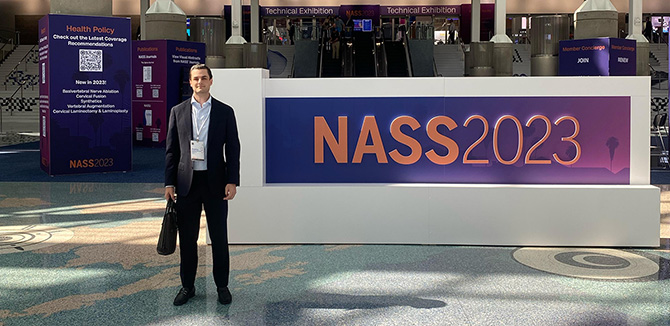
Roberto Valdés Sanchez-Navarro (MEM ‘22) still remembers the electric school bus project that captivated him during his time in Northwestern's Master of Engineering Management (MEM) program.
The idea of transforming something as ordinary as student transportation into a cleaner, smarter vehicle through vehicle-to-grid (V2G) battery technology sparked his enthusiasm for emerging innovation.
That same enthusiasm now drives a much bigger transformation. Valdés is leaving his role as an equity research associate at Morgan Stanley, where he had worked since 2023, to launch his own investment firm with a focus on acquiring and growing small businesses across North America.
“I’m truly enthusiastic about this new chapter,” Valdés said. “I’ll have the opportunity to bring together my background in engineering and finance to identify high-quality assets with untapped potential, accelerate their growth, and drive meaningful value creation. My goal is not only to deliver strong returns, but also to foster innovation, create jobs, and help bring better products and services to communities.”
The leap from Wall Street analyst to entrepreneur might seem dramatic, but it represents a natural evolution of skills Valdés developed through MEM and refined while on Morgan Stanley's medical technology research team.
At Morgan Stanley, Valdés authored more than 550 research notes, assessed merger and acquisition transactions and IPOs, and built expertise across the medical technology landscape — including brain-computer interfaces, orthopedics, spine technologies, and surgical robotics. He positioned himself as a bridge between cutting-edge medical innovation and global finance, translating complex technologies into actionable insights for investors and industry leaders.
“My engineering background allows me to understand the technical core of new medical devices and technologies,” Valdés said. “My finance experience enables me to translate that understanding into what it means for a company’s value, growth prospects, and ultimately, its stock performance.”
That ability to translate connects back to the MEM program’s unique curriculum. The program blends advanced engineering coursework with business fundamentals, preparing engineers to lead in technology-driven industries.
The MEM program gave Valdés what he calls dual fluency — the ability to operate seamlessly between the language of technology and the language of business. That combination equipped him with the confidence and perspective to launch his new venture.
One course proved particularly transformative: Decision Tools for Managers, taught by Amjed Shafique (MEM '04). The class taught Valdés systematic frameworks for tackling complex problems amidst uncertainty.
“That class gave me a disciplined way of thinking about problems analytically,” Valdés said. “It reinforced the idea that even very complicated choices can be approached methodically.”
Those decision-making frameworks became daily tools for Valdés at Morgan Stanley. In his role, he routinely applied that methodical approach to analyze companies with limited data and distilled complex insights into investment strategies for top-tier institutional clients, including some of the world’s largest hedge funds that manage billions of dollars.
His responsibilities evolved from building financial models as a new graduate to leading major research projects and mentoring junior colleagues. He moderated calls with renowned surgeons, contributed to IPO processes, and initiated coverage on cutting-edge companies developing everything from sleep apnea devices to surgical robotics.
Valdés is now turning that analytical rigor to small businesses with strong assets and clear growth potential. His goal is to leverage systematic efficiencies, operational discipline, and strategic synergies to create value and generate jobs.
“My interest isn't limited to companies with cutting-edge technology. It's in finding great assets with potential, then improving and scaling them,” Valdés said. "I believe there is tremendous opportunity to embed technology and innovation into almost any type of business, whether through digital tools, automation, or smarter processes.”
His entrepreneurial transition reflects MEM's emphasis on adaptability and continuous learning. Valdés credits the program with preparing him to rapidly master new industries and technologies, skills that proved invaluable when analyzing complex areas like medical devices and when navigating fast-moving market shifts.
Just as that electric school bus project during his MEM days showed him how innovation could transform something as ubiquitous as student transportation, Valdés now sees similar potential in traditional businesses across North America. The same curiosity that once led him to explore V2G battery technology now drives his search for companies ready for their own transformation.
“I’m driven by the opportunity to not just invest in businesses, but to create and own enterprises that endure,” he said. “My goal is to channel my experience into building companies that expand opportunity, leverage technology to spark innovation, and deliver lasting impact for both the economy and society.”