MEM, MPM Students Win National Competition
The Northwestern team of students overcame a rough start to win The College Project Competition, a four-month contest hosted by Michigan Technological University in collaboration with the Project Management Institute.
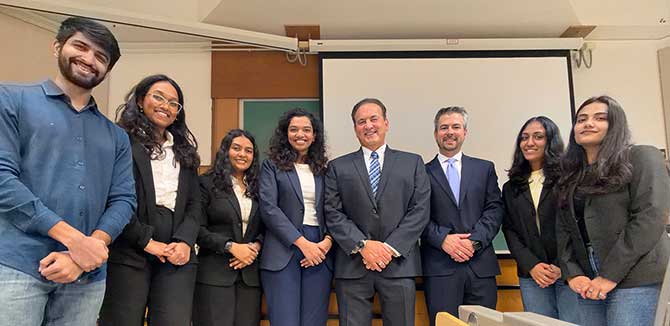
A team of students from Northwestern Engineering's Master of Science in Project Management (MPM) program and Master of Engineering Management (MEM) program won The College Project Competition (TCPC), a four-month-long contest for students across the country.
The victory almost didn't happen.
TCPC was hosted by Michigan Technological University in collaboration with the Project Management Institute (PMI). Each student team was asked to create a comprehensive project management plan for transforming a contaminated brownfield site into a sustainable public park. The project required teams to address environmental remediation, stakeholder engagement, ESG and governance strategies, risk management, budgeting, scheduling, and long-term community impact while applying PMI standards and Project Management Body of Knowledge (PMBOK) principles.
The competition was split into four gates—initiation, planning, execution readiness, and a final presentation with a complete project binder—and after receiving a low score for their Gate 1 work, Anushka Agrawal (MEM '26), Soumya Muthu Kumar (MEM '26), Khushi Jha (MEM '26), Dheeptha Rai J. Meenacshi (MEM '26), Sujit Rathod (MEM '26), and Sharvari Wani (MPM '26) were ready to quit.
"We didn't know what we were doing wrong," Sharvari said. "We were demotivated."
Sensing the team was disheartened, Sharvari turned to MPM director Shelley Finnigan, who connected the students with two MPM professors: Joseph Santucci and Carlo Santucci. The two mentored the team and helped re-energize each of the students.
The group decided to use the low score as motivation for the rest of the competition.
"Each gate was weighted equally in the final score, so even though we did poorly in Gate 1, we knew we could catch up if we were excellent in Gates 2, 3, and 4," Sujit said. "We took that as a challenge. We applied rigorous PMI standards across all fronts. We didn't cut corners. We also crafted the narrative in our presentation carefully. It wasn't just about process. It was about what the project meant: taking a contaminated eyesore and turning it into a community asset."
The students created a comprehensive project management plan that covered all five PMI process groups and knowledge areas: initiating, planning, executing, monitoring, and closing.
They appreciated that the competition tested them on discipline and execution, not just facts they could read in a textbook.
"It was real. We weren't working on a hypothetical," Anushka said. "We were managing a project with environmental uncertainty, regulatory oversight, infrastructure complexity, and public scrutiny, a private corporation funding remediation in partnership with a city. Real stakeholders. Real constraints. That made it interesting because we couldn't just theorize. We had to execute."
That execution—and the team's persistence—is what stood out to the mentors.
"Experiences like this help students develop critical thinking, communication, leadership, adaptability, and decision-making skills," Joseph Santucci said. "They learn that success is not just about technical accuracy, but also about collaboration, accountability, agility, and the ability to communicate ideas effectively under pressure."
Afterward, each of the students shared what they learned from the experience:
Anushka: "Schedule management is about critical path and float. It's about knowing which activities can slip and which ones can't. It's about planning for the things you can't control, like regulatory reviews. I learned that a schedule is a communication tool. It shows everyone what has to happen and when."
Dheeptha: "You don't need to be an expert in everything to lead. You need people who own their piece completely and trust each other. You need to ask good questions. You need to make sure everyone is connected. I also learned what great mentorship looks like. The professors didn't just advise us. They invested in us. That's something I want to do for others."
Khushi: "Community engagement has to be part of execution from the beginning. Stakeholders aren't obstacles. They're partners. If they don't trust you, your project fails. Engagement means listening, not just communicating."
Sharvari: "A single outside connection can change a team's trajectory. Reaching out to Professor Finnigan was just one conversation, but it completely changed the direction of our project. I learned that asking for help isn't a weakness. It's often the most important move you can make."
Soumya: "Risk management is foundational to everything. You can't just list risks and move on. You have to understand them. You have to plan responses. You have to monitor them. Safety and compliance aren't checkboxes. They're disciplines that protect people and the project."
Sujit: "Cost management in a complex project is about understanding uncertainty. Where are you uncertain? How do you quantify that? How do you build contingency? How do you defend your cost baseline to someone who knows the industry? I learned that cost isn't just a number. It's a system."