Engineering Creative Machines
Catherine Maglione (MSR ‘25) spent her MSR internship developing AI-driven painting systems for one of the most influential forces in contemporary art.
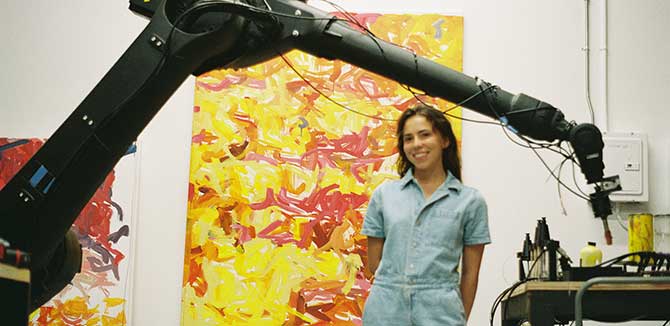
From vibrant yellows to muted grays, breathtaking blues to drab greens, the colors on an artist’s palette allow her to express the world as she sees it.
For Catherine Maglione (MSR '25), a summer internship opened up a rainbow of possibilities for a new type of artist: AI.
Catherine graduated from Northwestern Engineering's Master of Science in Robotics (MSR) program after being a robotics intern at Refik Anadol Studio, one of the most influential forces in contemporary media art. The studio blends AI, data, architecture, and immersive environments into large‑scale public installations.
Catherine’s internship focused on building a color dispensing and painting system for robotic artists that have ingested massive datasets to reimagine museums. The goal of studio founder Refik Anadol is to turn museums from buttoned-up archives of history to living displays that evolve alongside the humanity they are designed to reflect.
“What excited me most was the chance to build robotics inside a studio culture where technology serves emotion, experience, and critique,” Catherine said. “I’ve always been drawn to performance-centered robotics and systems that create dialogue with the public, so being able to prototype those kinds of tools in a deeply collaborative creative community felt incredibly aligned.”
Her work is at the foundation of just such a newly imagined museum, Dataland, which is scheduled to open this spring in California. Dataland is described as the world’s first museum of AI arts and will be housed at The Grand LA, in downtown Los Angeles.
Anadol and museum cofounder Efsun Erkiliç frame it as a permanent home for the studio’s decade of work across 70-plus cities and six continents. The museum spans 25,000 square feet and includes five major galleries, each designed as a fully immersive environment.
Catherine’s engineering work, built in collaboration with fellow intern Michelle Pan, involved developing the full control system for the robot artist.
In other words, she became part artist and part muse for the robot artist. In doing so, she fulfilled a bucket list dream of working with Anadol, who, among other accomplishments, created the 2025 TIME100 AI Cover.
Catherine said she first encountered his work while at the Museum of Modern Art in New York City, leading to her decision to pursue a master’s degree in robotics.
“I wanted a robotics program where art, embodiment, and experimentation could sit at the center of technical learning,” she said.
The MSR program’s project-based structure immediately captured her attention and directly led to her dream internship.
Anadol’s studio uses datasets sometimes reaching hundreds of millions of images to train custom AI models. Examples include 200 million photographs of Earth for a recent installation and 10 million glacier images for the Large Nature Model: Glacier project.
Large Nature Models are a proprietary generative-AI model trained exclusively on ethically sourced nature datasets, designed to visualize ecosystems, raise environmental awareness, and power climate‑focused installations.
These datasets serve as the inspiration for robots that use machine learning as a brush to generate constantly evolving visuals that are fluid, organic, and often hypnotic.
Catherine said her MSR coursework helped her find success in her internship and is now guiding her post-graduation direction. The Refik Anadol Studio recently hired her for a full-time position.
“MSR reinforced that ambitious work depends on community,” she said. “The program was demanding, and even while pursuing independent projects, cohort support played a major role. I’ve learned that strong work is built through continuous feedback and collaboration.”