Walking Wonder
Harrison Bounds (MSR ‘25) transformed his passion into motion with a custom-built hexapod project that coupled design ingenuity and advanced robotics.
Many robotics students start their journeys by tweaking existing designs, refining pre-built systems, or optimizing algorithms for machines already in motion. But Harrison Bounds (MSR ‘25) didn’t want to just modify.
Bounds wanted to build.
For his winter quarter independent project in Northwestern Engineering’s Master of Science in Robotics (MSR) program, Bounds designed, printed, assembled, and programmed a six-legged hexapod robot, tackling every step himself.
“I have a software background, so I wanted to do some hardware,” Bounds said. “I've always been fascinated by legged robots and locomotion. I thought it would be cool to build a hexapod. I don't see those very often.”
What started as an ambitious engineering challenge quickly evolved into a deep exploration of movement and machine learning. With inverse kinematics guiding its gait and a reinforcement learning algorithm helping it adapt, the hexapod transformed into more than just a project. It became a testament to the hands-on, immersive learning that defines the MSR program.
Bounds built the hexapod entirely from scratch, designing and 3D-printing every component before tackling the programming that would make it walk. Not satisfied with simply getting it to walk, Bounds went a step further by integrating a reinforcement learning algorithm, allowing the robot to train itself to move in simulation.
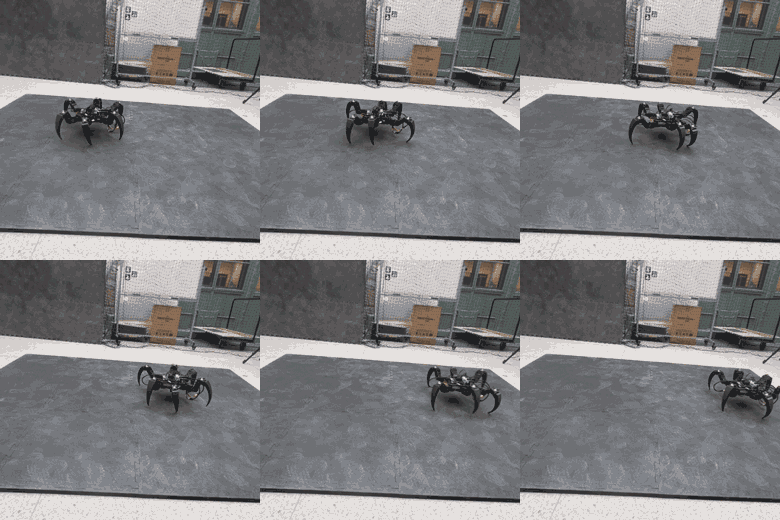
Heading into the project, he expected the physical construction to be the hardest part because of his lack of hardware experience. Instead, he discovered that designing the initial movement of the robot was far more challenging than assembling the parts. Writing the algorithm required multiple iterations to ensure the robot’s legs moved efficiently without dragging.
“It wasn’t working well at first,” Bounds said. “But it got better over time.”
Time is something Bounds said was critical to make the project a success. He began the quarter knowing he wanted to have something worthwhile to share in his portfolio, and he was willing to make the necessary commitment.
“If you want to make something good, you have to put in the work,” Bounds said. “I knew I wanted something I could show off, so I hunkered down and worked as much as I could.”
While he initially had doubts about whether he could reach his most ambitious goals, Bounds set structured fallback objectives to keep himself on track.
“I didn’t know if I would have enough time for reinforcement learning, so I set goals accordingly,” Bounds said. “I told myself, ‘OK, one thing I’m definitely going to do is build it, and if I can build it, then I can make it walk, and if I can make it walk, then I can put the algorithm on it.’”
That dedication and planning paid off. Bounds met all three goals.
His success was bolstered by the support of his peers in the MSR program, a tight-knit group of robotics enthusiasts with expertise in a variety of specialties. Bounds leaned on his cohort’s knowledge when facing roadblocks, drawing inspiration and insights that pushed his project forward.
“If I ever needed help, different people knew about different things,” Bounds said. “They were a huge source of inspiration because I could ask a friend who was good at one thing or another who was skilled in something else.”
With his independent project behind him, Bounds is now looking forward to using the skills he honed during the hexapod build as he prepares for his final project.
The experience taught him that ambitious goals can be met through persistence, collaboration, and strategic planning.
“The fallback goal is on the way to the dream goal,” Bounds said. “As long as you have steps to achieve your goal, even if you don’t reach the overarching dream, you’ve still made progress toward it.”