

Advancing Theory, Research, and Practice for Generative AI in Computing Education
On July 20, Northwestern Computer Science hosted a workshop on generative AI in computing education for practitioners, scholars, and instructors
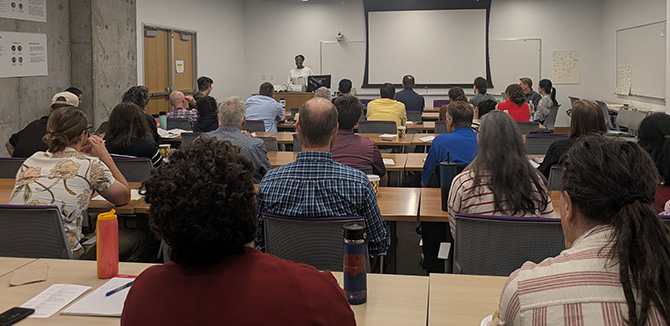 Workshop on Advancing Theory, Research, and Practice for Generative AI in University-Level Computing Education
Amid a rapidly changing generative AI (GenAI) landscape, Northwestern Computer Science convened 45 computing practitioners, scholars, and instructors. Together, they examined the pedagogical, ethical, and institutional questions the technologies raise for university-level education and workforce readiness training.
 “We shouldn’t rely on industry to guide us on how to prepare our students most effectively,” said workshop co-organizer Michael Horn, professor of computer science and of learning sciences. “Academic institutions have an important leadership role.”
During the interactive daylong workshop on July 20, cosponsored by Dolby Laboratories, lectures were interwoven with breakout discussions. Attendees shared lessons learned, developed ideas for their own classrooms, and explored new research projects and collaborations.
Invited speakers included:
- Jamie Gorson Benario, user experience researcher at Google
- Kevin Lin, associate teaching professor at the Paul G. Allen School of Computer Science and Engineering at the University of Washington
- Sepehr Vakil, associate professor of learning sciences at Northwestern’s School of Education and Social Policy
- Benjamin Xie, assistant professor of computer science at the University of Denver
Technical and ethical learning goals
As GenAI tools become embedded in everyday practice, the department aims to train students with a strong ethical framework, covering how and when the tools should be used in software engineering. Workshop participants agreed that instructors have a role to play in cultivating students' ethical and critical thinking around these technologies. Just as importantly, discussions emphasized that students themselves deserve a voice in policy and practice conversations.
While the specifics remain unsettled, the workshop also surfaced a clear cluster of central learning goals in computing education including problem solving, the ability to verify AI-generated code; and building essential skills like algorithmic thinking, analytical reasoning, and navigating multiple layers of abstraction.
Protecting the social fabric of learning
Because learning is an inherently social activity, workshop participants underscored the need to actively protect this dimension, as GenAI tools can make it easier for students to work in isolation. The ideas floated included expanding peer review, building shared class artifacts, and deliberately preserving space for connection between students and teaching faculty. Attendees also pointed to project-based, community-engaged learning as a promising path forward—one that centers authentic problems, and helps students grow as critical thinkers, creative problem-solvers, and effective communicators, skills that remain distinctly human contributions even as AI tools handle more routine tasks.
 “I'm excited about the ideas from the workshop and hope they spark new research directions and changes in classrooms as early as this fall,” said workshop co-organizer Melissa Chen, a PhD candidate in computer science advised by Professor Eleanor O'Rourke. “The disruption caused by generative AI gives us an opportunity to recenter and reimagine anything, from the purpose of a university education to how we assess students, and I hope we take this chance to dream of a better future.”
The “Workshop on Advancing Theory, Research, and Practice for Generative AI in University-Level Computing Education” was also supported by organizing committee faculty members Samir Khuller, Anastasia Kurdia, Sara Sood, and Yiji Zhang.