

PhD Grad Spotlight: Rashna Kumar
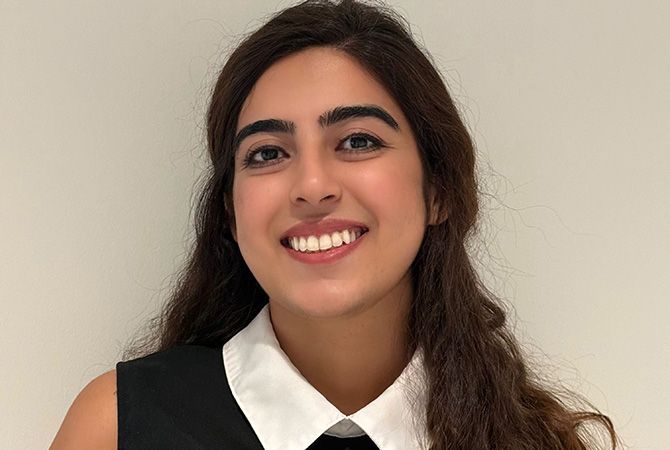
Kumar is graduating with a PhD in computer science
Considering how inextricable the Internet is to so much of daily life—from communication, education, and shopping to banking, healthcare, and government services—service interruptions are anywhere from mildly troubling to massively catastrophic.
Rashna Kumar, who graduates this month with a PhD in computer science, investigates the resilience of computer networks, with a focus on Internet and web delivery infrastructure. She examines how well these systems can continue to function when something goes wrong, the main threats to the Internet’s stability, and how they affect people and institutions.
“I also care about the policy side of these questions, so that my research can help guide better decisions about how digital infrastructure is deployed, managed, and regulated,” said Kumar, who was advised by Professor Fabián E. Bustamante and a member of the AquaLab.
In her dissertation, “Consolidation and Consequence in Web Delivery Infrastructure,” Kumar studied network dependencies on the web and the economic, political, and reliability implications of Internet consolidation trends that concentrate Internet traffic, infrastructure, services, and users on a handful of providers.
By examining not just where content is hosted, but the full path between users and the services they access, Kumar demonstrated that consolidation in web infrastructure is widespread across countries, sectors, and services, including government services websites, where dependencies can raise additional questions of control and sovereignty. She developed methods and datasets to map resilience-threatening dependencies, identifying both where single points of failure may emerge, and whether those patterns reflect limited local infrastructure options or institutional choices.
“This distinction matters because it points to different responses: where infrastructure options are limited, the answer may be to build more local capacity, while where dependence is more a matter of choice, better policy, incentives, or procurement decisions may help encourage more resilient alternatives,” Kumar said. “My work contributes to a growing effort in computer science to study the Internet not just as a technical system, but as critical infrastructure that shapes access, reliability, and control around the world.”
Kumar’s dissertation research was supported in part by Comcast.
We caught up with Kumar to learn more about her experience earning a doctoral degree, impactful interdisciplinary experiences, problem-solving inspiration, and her advice for students.
Why did you decide to pursue a PhD in computer science at McCormick?
I’ve always been drawn to asking open-ended questions, solving hard problems, and studying systems that affect people at a very large scale. What appealed to me most was the chance to combine technical depth with real-world impact. The Internet, in particular, felt especially important to study because billions of people rely on it every day. I wanted to better understand the network infrastructure that keeps it running, how that infrastructure is changing over time, and how those changes affect users, institutions, and society.
McCormick and Northwestern felt like the right place for that work because of the strength of the systems and networking research here, the interdisciplinary environment, and the culture of asking broader questions about technology and society. It was a place where I felt I could do rigorous technical research while also asking bigger questions about the societal importance of the systems we build. Working with Fabian was also one of the main reasons I chose Northwestern for my PhD, and it has played an immense role in my growth, helping me become a stronger researcher, presenter, and writer.
Whose research—inside or outside your immediate area—most shaped how you approach problems? Are there papers, books, or conversations that you keep returning to?
Outside my immediate area, one idea I keep returning to is from Atomic Habits by James Clear (Avery, 2018): meaningful progress often comes from building systems and small, consistent practices. Reading the book during my PhD helped me put ideas like habit stacking and system building into practice, which made it easier to rely less on motivation and more on consistent action.
Another piece of advice that stayed with me came from a CRA-WP Grad Cohort Workshop, where the discussion emphasized that not every research problem has to carry the full burden of impact on its own. It reminded me that impact can happen in many ways, through teaching, mentoring, community building, departmental service, and research as one part of that larger picture. Rather than forcing every project to immediately answer the biggest societal question, I have learned to value careful technical work while also looking for thoughtful ways to connect it to the broader world.
What are some specific examples of collaborative or interdisciplinary experiences at Northwestern that were notably impactful to your research?
One of the most impactful aspects of my PhD at Northwestern has been the opportunity to collaborate across academia, industry, and public-interest organizations. Most recently, my work with the Internet Society (ISOC) through the Internet Society Pulse Research Fellowship was especially meaningful because it allowed me to connect rigorous Internet measurement research to public-facing questions. That work helped me think more deeply about how technical measurements of Internet consolidation and resilience can inform broader conversations about infrastructure sovereignty and Internet governance, and ISOC also provided me a platform to translate technical findings into public-facing writing and policy-relevant outputs.
Northwestern’s interdisciplinary environment also gave me the opportunity to learn outside my home department. Through the 2025 Summer Management for PhDs program—a partnership between The Graduate School and Kellogg School of Management—I learned practical strategies for values-driven leadership and mentoring. I also gained tools for building inclusive, engaging learning environments, drawing on sessions that offered excellent examples of the effectiveness of storytelling, real-world examples, and interactivity. I also took Kellogg’s Corporate Social Innovation course alongside MBA students. The course examined how companies respond to major social challenges through corporate social responsibility strategies, which was especially meaningful because it gave me a language for thinking about infrastructure not only in terms of efficiency and performance, but also in terms of institutional responsibility and broader social outcomes.
Together, these experiences helped me become a stronger researcher and communicator, and they deepened my commitment to research that combines technical depth with real-world impact.
What advice do you have for current or prospective Northwestern Computer Science PhD students?
Remember that a PhD is as much about learning how to handle uncertainty as it is about doing research. Choose problems and work that you genuinely care about, because that sense of purpose can help keep things in perspective during setbacks, uncertainty, and rejection. It is also important to make space for hobbies and interests outside research, to be able to step away from it when needed and return with a fresh perspective. Finally, I would encourage taking part in social and networking opportunities, both within the department and at conferences, because it really takes a community to get through a PhD.
Beyond research, what experiences during your PhD—teaching, mentoring, internships, conferences, or life outside the lab—were most meaningful to you, and why?
Co-teaching a course was an especially rewarding experience. Some of the most meaningful moments came after class, when curious students would often stay to ask conceptual questions, talk about current networking research, and discuss how my own work connected to what they were learning. Conferences were deeply meaningful as well, not only because they created space to brainstorm and discuss ideas but also because they connected me with students from different universities and countries who were navigating many of the same experiences.
Outside of academic spaces, I found a lot of meaning in experiences that helped me stay grounded and balanced, like boxing. I initially took it up for health and improving energy levels, but it became much more than that. It was incredibly helpful for my mental health and gave me a way to step away from research when needed, then return with a clearer mind and fresh perspective. I also appreciated being so close to Chicago and getting to explore its vibrant city life with friends. I loved taking Norris Mini Courses as well, which let me explore a wide range of interests, from knitting to contemporary dance to acting. Those experiences brought joy and balance to my PhD and doing them alongside people from different programs and disciplines at Northwestern reminded me how valuable it is to stay curious and connected beyond research.
What's next?
In the short term, I will continue my research at the intersection of computer networks and policy as a postdoctoral researcher at Northwestern, while also teaching as an instructor of record in the coming year.
In the long term, I hope to build a career that combines rigorous research, meaningful teaching, mentorship, and real-world impact. My broader research goal is to help build an Internet that is not only efficient and scalable, but also resilient and better aligned with the needs of the societies that depend on it.